Exploring Geometry, Research, and Community: A Conversation with Nicola Tarasca
March 23, 2026
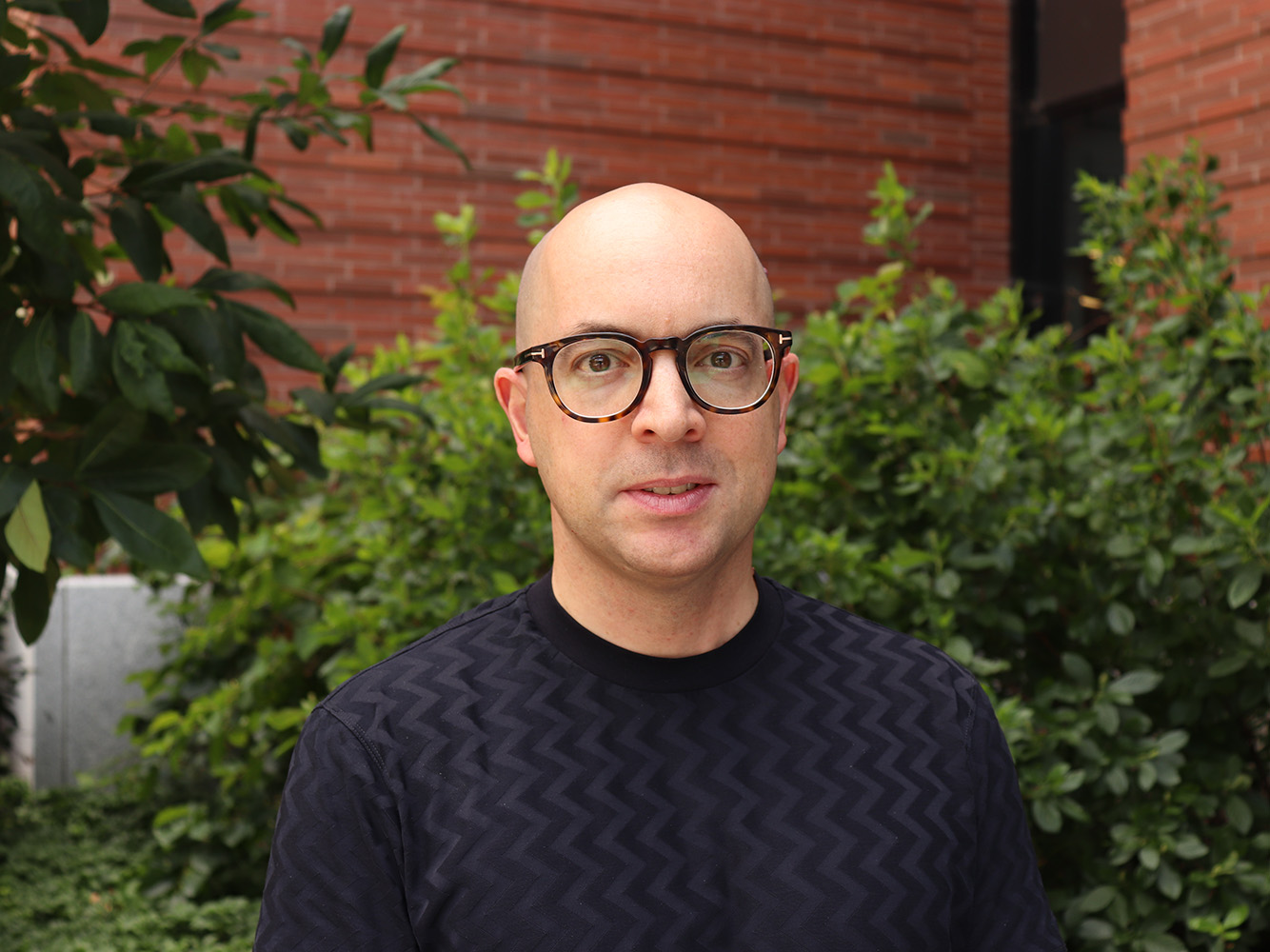
Nicola Tarasca, an associate professor in the Department of Mathematics at Virginia Commonwealth University, has spent years exploring the depths of algebra and geometry. Since joining VCU in 2019, Tarasca has balanced teaching, research, and mentorship within the university’s growing mathematical community.
Although Tarasca’s expertise lies in advanced mathematical theory, his teaching spans a wide range of levels, from introductory undergraduate courses to graduate seminars. This semester, however, Tarasca is taking advantage of a sabbatical to focus primarily on research.
“It's been an interesting experience so far,” he says. “I’ve had the chance to focus on writing and pushing my research forward, but I still like to keep a consistent routine: coming to campus and working out of my office.”
Tarasca’s current research builds on work he has been developing over the past several years. His project centers on constructing geometric structures within specialized mathematical spaces known as moduli spaces. In simple terms, these spaces organize many mathematical objects, such as algebraic curves, into families.
Rather than studying each object individually, Tarasca examines how entire collections of objects interact when viewed together. “Each point in these spaces represents a variety itself,” he explains. “So instead of looking at single objects, you’re studying a whole family of them and how they form a geometric structure.”
In addition to his research, Tarasca helps organize the Richmond Geometry Meeting, a collaborative event designed to bring together mathematicians and students interested in geometry.
The initiative grew out of a desire to strengthen the geometry community at VCU and provide opportunities for graduate students to share their work. Supported by the National Science Foundation (NSF), the meetings originally began online but have since transitioned to in-person gatherings.
“Our goal was to create a space that is collaborative and discussion-based,” Tarasca says. “We want people, especially those early in their careers—to feel comfortable presenting their work and engaging with others.”
The meetings aim to strike a careful balance: accessible enough for a broad audience, but still advanced enough to introduce new and technical ideas.
Helping Students Overcome Math Intimidation
For many students, subjects like geometry and algebra can feel intimidating. Tarasca believes the key to overcoming that challenge is building a strong conceptual foundation and allowing students to develop their own mathematical intuition.
“Everyone has to find their own path,” he says. “It’s important to work hands-on with concepts at the beginning and take things step by step. Once you develop intuition, you can start building toward more complex ideas.” As a mentor, Tarasca tries to provide clear entry points into difficult topics, helping students gain confidence before advancing into deeper theoretical work.
Tarasca is also involved in VCU’s Geometry Camp, an outreach initiative aimed at engaging middle school students in mathematics through hands-on learning.
The program is a collaboration between faculty in the Mathematics Department and the School of Education. A team of five educators designed activities that introduce geometric concepts without requiring any prior mathematical background. “Once they can hold something in their hands that they constructed, it makes the ideas much more tangible,” he says.
While Tarasca enjoys teaching courses at all levels, he finds particular satisfaction in upper-level classes where the material connects more closely to research.
One course he particularly values is Introduction to Mathematical Reasoning, which helps students transition from computational courses like calculus into proof-based mathematics. The class emphasizes understanding algorithms, modifying them, and thinking critically about mathematical logic.
“Those skills don’t just apply to math,” Tarasca notes. “They help students communicate clearly and think analytically in many areas of life.”